
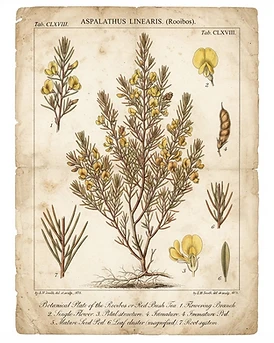
Aspalathus linearis
Rooibos
Fabaceae
Identity
- Common Name
- Rooibos
- Scientific Name
- Aspalathus linearis
- Botanical Family
- Fabaceae
- Native Region
- Cederberg region of South Africa
- Cultivation Regions
- South Africa (Western Cape)
- Plant Parts Used
- Leaves
- Synonyms
- Red bush tea, African red tea
- Caffeine Level
- Caffeine Free
A shrubby legume with needle-like leaves and small yellow flowers. The green leaves are bruised and oxidized (fermented) to produce the familiar reddish-brown tea.
Historical Background
Rooibos has been used by the indigenous Khoisan peoples of South Africa for centuries. It was popularized commercially in the early 20th century and has since become a globally loved caffeine-free tea.
Earliest recorded uses: Long used by the Khoisan people of the Cederberg mountains.
Cultural significance: A symbol of South African heritage; an important agricultural product of the Western Cape.
Pre-colonial
Used traditionally by Khoisan peoples.
Early 20th century
Commercial cultivation began.
Late 20th century
Gained international popularity as a caffeine-free tea.
Traditional preparations:
- Decoction (boiled)
- Long steeping with milk and honey
Traditional Uses
These uses document historical traditions and do not imply proven effectiveness.
Indigenous Traditions
Used by the Khoisan as a refreshing mountain tea and tonic.
Modern Herbalism
Enjoyed worldwide as a naturally caffeine-free, low-tannin alternative to black tea.
Flavor & Aroma
Aroma: Warm, honeyed, slightly smoky.
Tea Information
Safety & Cautions
Research Summary
Rooibos contains antioxidants such as aspalathin. Most health claims are based on laboratory and animal studies; robust human clinical evidence is limited.
Evidence levels reflect the currently available scientific literature and may change as new research emerges. Where evidence is limited or conflicting, this is stated plainly.
References & Sources
References & Sources
- NIH Office of Dietary Supplements · Botanical dietary supplements background (2023)
- PubMed · Aspalathus linearis (rooibos) — reviews of composition and bioactivity (2019)
- Memorial Sloan Kettering · Rooibos - Integrative Medicine (2023)
Related Herbs


Cyclopia genistoides
Honeybush
Fabaceae
Sweet, honey-like, woody, floral


Ceratonia siliqua
Carob
Fabaceae
Sweet, cacao-like, nutty, slightly toasty

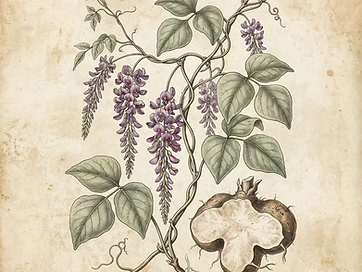
Pueraria lobata
Kudzu
Fabaceae
Sweet, starchy, slightly floral, earthy