
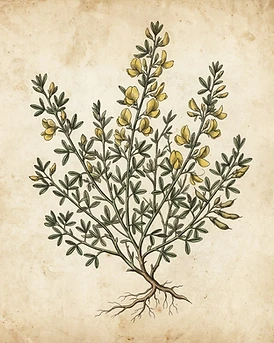
Cyclopia genistoides
Honeybush
Fabaceae
Identity
- Common Name
- Honeybush
- Scientific Name
- Cyclopia genistoides
- Botanical Family
- Fabaceae
- Native Region
- South Africa (Cape fynbos)
- Cultivation Regions
- South Africa (Eastern & Western Cape)
- Plant Parts Used
- Leaves, Twigs
- Synonyms
- Heuningbos, Cape Honeybush
- Caffeine Level
- Caffeine Free
A shrubby legume with slender green woody stems, trifoliate leaves of small narrow leaflets, and bright yellow pea-like flowers; the leaves and twigs are fermented and dried for a honey-scented tea.
Historical Background
Honeybush is the gentle cousin of rooibos, gathered for centuries from the fynbos hills of South Africa's Cape, where Indigenous Khoisan and later settlers brewed its honey-scented leaves as a soothing caffeine-free tea. Like rooibos, it is naturally low in tannin and a beloved everyday brew.
Earliest recorded uses: Traditional Khoisan and early Cape settler use as a daily caffeine-free tea; exported from South Africa since the 19th century.
Traditional preparations:
- Fermented-leaf infusion
- Honeybush-milk tea
- Blends with rooibos
Traditional Uses
These uses document historical traditions and do not imply proven effectiveness.
African Traditions
Daily caffeine-free, honey-scented restorative tea.
Modern Herbalism
Soothing antioxidant evening tea.
Flavor & Aroma
Aroma: Sweet, honey-like, woody, floral
Tea Information
Safety & Cautions
Research Summary
Honeybush has a long tradition as a soothing, caffeine-free tea. Preclinical work shows antioxidant activity (mangiferin, polyphenols); clinical evidence is limited and it is not a treatment for menopause, osteoporosis, or any disease.
Evidence levels reflect the currently available scientific literature and may change as new research emerges. Where evidence is limited or conflicting, this is stated plainly.
References & Sources
Related Herbs


Aspalathus linearis
Rooibos
Fabaceae
Warm, honeyed, slightly smoky.


Trifolium pratense
Red Clover
Fabaceae
Mild, sweet, floral, grassy


Ceratonia siliqua
Carob
Fabaceae
Sweet, cacao-like, nutty, slightly toasty