Educational reference only · Not medical advice
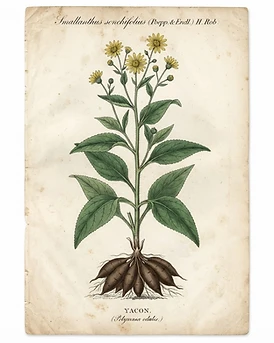
Botanical illustration of Yacon

Smallanthus sonchifolius

Yacon

Asteraceae

Evidence: LimitedCaffeine Free Andes / South AmericaSafety information on file
Save to favorites

At a Glance

Common name
Yacon
Scientific name
Smallanthus sonchifolius
Family
Asteraceae
Region
Andes / South America
Plant part
Tubers, Leaves
Caffeine
Caffeine Free
Evidence
Limited
Safety review
Safety information on file

Safety & Cautions

Safety information on file
Contraindications
Generally very safe in food/tea amounts; high in fructooligosaccharides - may cause gas/bloating if unaccustomed; caution with antidiabetic drugs (may lower blood sugar).
Drug interactions
May lower blood sugar - caution with antidiabetic drugs; high FOS may affect absorption - consult a clinician.
Pregnancy
Generally regarded as safe in food amounts.
Breastfeeding
Generally regarded as safe in food amounts.
Children
Very gentle; widely enjoyed in foods and infusions.
Allergies
Possible in those sensitive to Asteraceae; may cross-react with sunflower/ragweed.
Known adverse effects
Generally very well tolerated; high doses may cause GI upset, gas, or bloating; rare allergic reactions (Asteraceae).

Botanical Description

A tall perennial with large broad hairy lanceolate green leaves, small yellow daisy-like composite flowers, and a cluster of plump brown tuberous storage roots at the base; the tubers are used.

Also known as: Bolivian Sunroot, Peruvian Ground Apple

Historical Background

Yacon has been an Andean food and drink since pre-Columbian times, its sweet crisp tubers eaten fresh or dried and brewed into a gentle, low-calorie, prebiotic tea. Treasured for its natural sweetness, it offers a caffeine-free cup with a modest blood-sugar tradition.

Earliest recorded uses: Andean traditions since pre-Columbian times; a sweet, crisp tuber and root tea.

Traditional preparations:

  • Dried-tuber decoction
  • Leaf infusion
  • Sweet prebiotic tea

Traditional Uses

These uses document historical traditions and do not imply proven effectiveness.

Andean Traditions

Sweet Andean tuber and prebiotic tea.

Modern Herbalism

Gentle blood-sugar-friendly cup.

Flavor & Aroma

SweetMildSlightly EarthyFresh

Aroma: Sweet, mild, slightly earthy, fresh

Tea Preparation

Preparation methods
Dried-tuber decoction, Leaf infusion
Steeping temperature
Simmer (212 F / 100 C)
Steeping time
Decoct 8-10 minutes
Recommended vessel
Saucepan or teapot
Blends well with
Mint, Lemon Peel, Honey, Cinnamon, Ginger
Simmer (212 F / 100 C) Decoct 8-10 minutes

Modern Evidence

Evidence level: Limited

Yacon has a tradition as a sweet prebiotic and blood-sugar-friendly tea; preclinical and small trials show fructooligosaccharide (FOS) prebiotic and modest glucose-modulating activity. Clinical evidence is limited; it is not a treatment for diabetes, obesity, or any disease, though it remains a gentle, naturally sweet cup.

Evidence levels describe the state of research for the traditional use discussed here, not a recommendation. Historical use does not imply effectiveness.

References & Sources

  1. EMA HMPC · Smallanthus assessment (2015)
  2. PubMed · Smallanthus sonchifolius review (2019)

Entry last updated August 4, 2026

Soothing Brews

An educational encyclopedia preserving the history, traditions, and modern evidence behind herbs used in teas and infusions. Inspired by antique botanical manuscripts.

Steeped in tradition, grounded in honesty.

Please Note

This is an educational reference, not a medical resource. Historical use does not imply effectiveness. Natural does not always mean safe. Consult a qualified healthcare professional before using herbs, especially if pregnant, nursing, or taking medications.

© 2026 Soothing Brews · For educational purposes only. · Privacy Policy

Preferred sources: NIH ODS · NCCIH · MSK Herbs · PubMed · WHO · EMA · German Commission E · Cochrane