
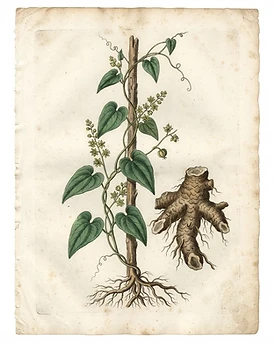
Dioscorea villosa
Wild Yam
Dioscoreaceae
Identity
- Common Name
- Wild Yam
- Scientific Name
- Dioscorea villosa
- Botanical Family
- Dioscoreaceae
- Native Region
- Eastern and central North America
- Cultivation Regions
- Eastern North America, Mexico, Central America
- Plant Parts Used
- Root (rhizome)
- Synonyms
- Colic Root, Rheumatism Root, American Yam
- Caffeine Level
- Caffeine Free
A climbing vine with heart-shaped pointed leaves in alternate arrangement and tiny greenish-yellow flowers, with a large knobby tuberous root — the part used and rich in diosgenin.
Historical Background
Wild yam has been used by Native American peoples and early Eclectic physicians for digestive and women's comfort, and its diosgenin later became the source material for the first oral contraceptives. Brewed as a root decoction, it remains a tradition-rich women's and digestive herb.
Earliest recorded uses: Native American and early American Eclectic medicine for centuries; a digestive and women's herb; source of diosgenin for early steroid synthesis.
Traditional preparations:
- Root decoction
- Women's blend with dong quai
- Bitter digestive tea
Traditional Uses
These uses document historical traditions and do not imply proven effectiveness.
Native American Traditions
Digestive and women's comfort; antispasmodic root.
Modern Herbalism
Women's and digestive root tea.
Flavor & Aroma
Aroma: Earthy, starchy, slightly bitter
Tea Information
Safety & Cautions
Research Summary
Wild yam has a tradition for digestive and women's comfort. The body does not convert diosgenin to progesterone (a marketing myth). Clinical evidence is insufficient and it is not a treatment for menopause, PMS, or any disease.
Evidence levels reflect the currently available scientific literature and may change as new research emerges. Where evidence is limited or conflicting, this is stated plainly.
References & Sources
Related Herbs


Polygonum multiflorum
Fo-Ti
Polygonaceae
Earthy, slightly bitter, starchy, mild


Carthamus tinctorius
Safflower
Asteraceae
Mild, slightly bitter, green


Cynara cardunculus
Artichoke Leaf
Asteraceae
Mild, slightly bitter, green, earthy