
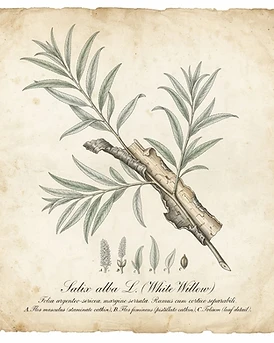
Salix alba
White Willow Bark
Salicaceae
Identity
- Common Name
- White Willow Bark
- Scientific Name
- Salix alba
- Botanical Family
- Salicaceae
- Native Region
- Europe and Asia
- Cultivation Regions
- Europe, Asia, temperate regions
- Plant Parts Used
- Bark (dried inner bark)
- Synonyms
- Salix, Willow Bark, European Willow
- Caffeine Level
- Caffeine Free
A deciduous tree with narrow lanceolate finely serrated silvery-green leaves and deeply furrowed gray-brown bark; the dried inner bark is used.
Historical Background
White willow bark has been a pain and fever remedy since ancient Egypt and Greece, its salicin-rich bark the natural blueprint for modern aspirin. Sipped as a decoction for centuries, it remains one of the best-evidenced herbal pain traditions, with a clear pharmacological basis.
Earliest recorded uses: Egyptian, Greek, and European traditions for millennia; the original source of salicin, the blueprint for aspirin.
Traditional preparations:
- Bark decoction
- Pain and fever tea
- Joint comfort cup
Traditional Uses
These uses document historical traditions and do not imply proven effectiveness.
Egyptian and Greek Traditions
Pain, fever, and inflammatory discomfort remedy.
European Traditions
Salicin-rich pain tea (aspirin blueprint).
Flavor & Aroma
Aroma: Earthy, slightly bitter, woody, astringent
Tea Information
Safety & Cautions
Research Summary
White willow bark has moderate evidence for low-back and joint pain, owing to salicin (a salicylate prodrug); it is not a substitute for medical pain care and carries salicylate-type risks. It is not a treatment for fever, headache, or any disease, though its pain tradition is among the best-supported in herbalism.
Evidence levels reflect the currently available scientific literature and may change as new research emerges. Where evidence is limited or conflicting, this is stated plainly.
References & Sources
Related Herbs


Ptychopetalum olacoides
Muira Puama
Olacaceae
Earthy, woody, slightly bitter

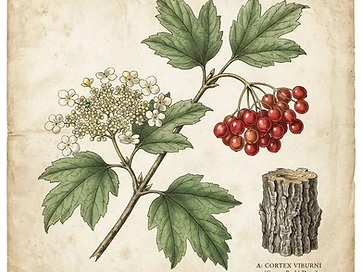
Viburnum opulus
Cramp Bark
Adoxaceae
Earthy, slightly bitter, woody

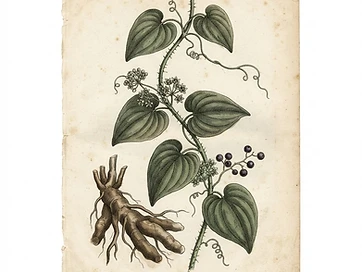
Smilax officinalis
Sarsaparilla
Smilacaceae
Earthy, sweet, slightly bitter, woody