
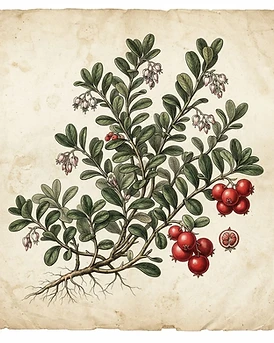
Arctostaphylos uva-ursi
Uva Ursi
Ericaceae
Identity
- Common Name
- Uva Ursi
- Scientific Name
- Arctostaphylos uva-ursi
- Botanical Family
- Ericaceae
- Native Region
- Northern Hemisphere temperate and arctic regions
- Cultivation Regions
- Northern Hemisphere (circumboreal)
- Plant Parts Used
- Leaves
- Synonyms
- Bearberry, Kinnikinnick, Upland Cranberry
- Caffeine Level
- Caffeine Free
A low trailing evergreen groundcover with small glossy dark green spoon-shaped leathery leaves, small pink-white bell-shaped flowers, and clusters of bright red berries (bearberries).
Historical Background
Uva ursi ('bear grape') has been used by Indigenous North American and European peoples for centuries as a urinary-tract comfort herb. Bears were said to eat the berries after winter hibernation, lending it the name 'bearberry.' The leaves are infused or decocted for short-term use.
Earliest recorded uses: Indigenous North American and European traditions as a urinary tract herb for centuries.
Traditional preparations:
- Leaf infusion
- Short-term urinary tea
- Blended with marshmallow & cornsilk
Traditional Uses
These uses document historical traditions and do not imply proven effectiveness.
Indigenous Traditions
Short-term urinary-tract comfort and astringent tonic.
Modern Herbalism
Short-term urinary-tract tea (not for daily long-term use).
Flavor & Aroma
Aroma: Astringent, earthy, green, mildly bitter
Tea Information
Safety & Cautions
Research Summary
Uva ursi has a tradition as a short-term urinary-tract comfort herb (arbutin). Clinical evidence is limited and it is not a treatment for UTI; do not use long-term. Any urinary symptoms warrant professional evaluation to rule out infection.
Evidence levels reflect the currently available scientific literature and may change as new research emerges. Where evidence is limited or conflicting, this is stated plainly.
References & Sources
Related Herbs


Vaccinium myrtillus
Bilberry
Ericaceae
Fruity, slightly tart, green, earthy

Vaccinium macrocarpon
Cranberry
Ericaceae
Fresh, fruity, sharp


Terminalia chebula
Haritaki
Combretaceae
Astringent, slightly sour, earthy, green