

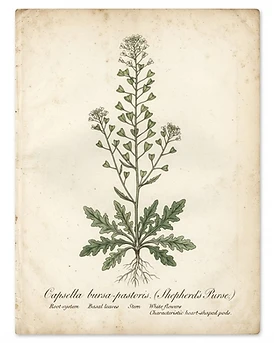
Capsella bursa-pastoris
Shepherd's Purse
Brassicaceae
Identity
- Common Name
- Shepherd's Purse
- Scientific Name
- Capsella bursa-pastoris
- Botanical Family
- Brassicaceae
- Native Region
- Europe and western Asia
- Cultivation Regions
- Worldwide temperate (often a wild plant)
- Plant Parts Used
- Aerial parts
- Synonyms
- Shepherd's Pouch, Mother's Heart, St James's Wort
- Caffeine Level
- Caffeine Free
A slender annual with a basal rosette of lobed leaves, an upright stem of tiny white flowers, and distinctive flat heart-shaped (purse-like) seed pods. Common in disturbed ground worldwide.
Historical Background
Used in European and Asian folk medicine as a hemostatic — most famously for heavy menstrual bleeding and as a wound styptic — shepherd's purse was also eaten as a potherb.
Earliest recorded uses: Heavy menstrual bleeding, nosebleeds, wounds, and as a urinary tonic.
Cultural significance: Named for its heart-shaped pods; a common cottage-garden styptic, it entered WWI field practice as a substitute for ergot.
Folk
European and Asian folk use as a styptic and menstrual remedy.
WWI
Used as a field hemostatic when ergot was scarce.
Traditional preparations:
- Infusion
- Fresh plant tincture
- Poultice
Traditional Uses
These uses document historical traditions and do not imply proven effectiveness.
Traditional European Herbalism
Infusion for heavy menstrual bleeding and as a wound styptic.
Flavor & Aroma
Aroma: Fresh, mustard-green
Tea Information
Safety & Cautions
Research Summary
Choline, flavonoids, and a peptide (bursin) are studied; traditional hemostatic use has limited modern clinical support.
Evidence levels reflect the currently available scientific literature and may change as new research emerges. Where evidence is limited or conflicting, this is stated plainly.
References & Sources
References & Sources
- American Herbal Products Association · Botanical Safety Handbook (2013)
Related Herbs


Nasturtium officinale
Watercress
Brassicaceae
Peppery, fresh, green, slightly mustard-like

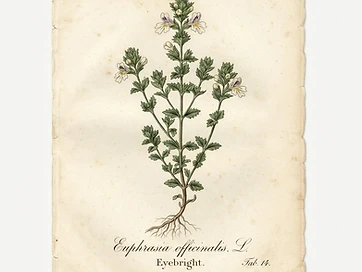
Euphrasia officinalis
Eyebright
Orobanchaceae
Faint, green and herbaceous

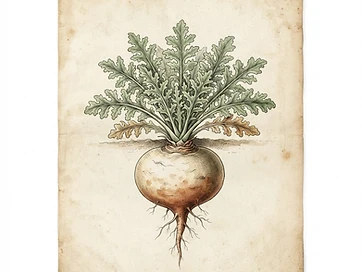
Lepidium meyenii
Maca
Brassicaceae
Earthy, slightly caramelized