
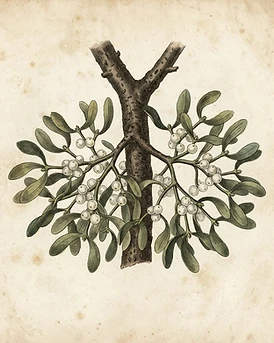
Viscum album
Mistletoe
Santalaceae
Identity
- Common Name
- Mistletoe
- Scientific Name
- Viscum album
- Botanical Family
- Santalaceae
- Native Region
- Europe and western Asia
- Cultivation Regions
- Europe, Western Asia, temperate regions
- Plant Parts Used
- Aerial parts (young twigs & leaves)
- Synonyms
- European Mistletoe, Viscum, Druid's Herb
- Caffeine Level
- Caffeine Free
An evergreen hemi-parasitic shrub forming dense round clumps on host tree branches, with thick leathery oblong green leaves in pairs and small round translucent white berries; the aerial parts are used.
Historical Background
Mistletoe has been a sacred plant of Celtic and Druidic winter rituals for millennia, a symbol of peace and healing under the oak. A gentle European tea tradition used it for circulation and calm, though the raw plant requires caution.
Earliest recorded uses: Celtic, Druidic, and European folk traditions for millennia; a sacred winter plant of peace and healing.
Traditional preparations:
- Cold infusion of twigs & leaves
- Circulation tea with hawthorn
- Winter calm blend
Traditional Uses
These uses document historical traditions and do not imply proven effectiveness.
Traditional European Herbalism
Sacred winter plant of peace and healing; circulation tea.
Modern Herbalism
Gentle circulation and calming tea (caution required).
Flavor & Aroma
Aroma: Mild, slightly bitter, green
Tea Information
Safety & Cautions
Research Summary
Mistletoe has a European folk tradition for circulation and calm; parenteral mistletoe extracts are studied as cancer therapy support in some countries, but oral tea evidence is insufficient. It is not a treatment for hypertension, cancer, or any disease; use only with clinician oversight.
Evidence levels reflect the currently available scientific literature and may change as new research emerges. Where evidence is limited or conflicting, this is stated plainly.
References & Sources
Related Herbs

Eclipta prostrata
Bhringraj
Asteraceae
Mild, slightly bitter, green


Tribulus terrestris
Tribulus
Zygophyllaceae
Mild, slightly bitter, green

Borago officinalis
Borage
Boraginaceae
Mild, slightly cucumber-like, green, floral