
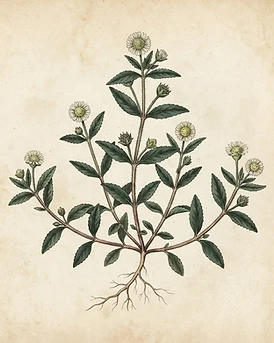
Eclipta prostrata
Bhringraj
Asteraceae
Identity
- Common Name
- Bhringraj
- Scientific Name
- Eclipta prostrata
- Botanical Family
- Asteraceae
- Native Region
- India and tropical Asia
- Cultivation Regions
- India, Southeast Asia, tropics
- Plant Parts Used
- Whole plant
- Synonyms
- Bhringaraja, False Daisy, Kehraj
- Caffeine Level
- Caffeine Free
A low spreading annual with small opposite oblong toothed dark green leaves and small white daisy-like flowers with a pale center, growing from a slender root; the whole plant is used.
Historical Background
Bhringraj ('king of hair') has been a prized Ayurvedic herb for millennia, used for hair, liver, and skin. The whole plant is brewed into a gentle tea traditionally associated with hair and digestive traditions.
Earliest recorded uses: Used in Ayurvedic medicine for millennia; a revered hair, liver, and skin herb (bhringaraja).
Traditional preparations:
- Whole-plant infusion
- Hair & liver tea
- Ayurvedic vitality blend
Traditional Uses
These uses document historical traditions and do not imply proven effectiveness.
Ayurveda
'King of hair'; liver, hair, and skin herb.
Modern Herbalism
Hair, liver, and skin tea.
Flavor & Aroma
Aroma: Mild, slightly bitter, green
Tea Information
Safety & Cautions
Research Summary
Bhringraj has a long Ayurvedic tradition for hair, liver, and skin. Clinical evidence is insufficient; preclinical work shows hepatoprotective and hair-growth activity in animals, but it is not a treatment for hair loss, liver disease, or any condition.
Evidence levels reflect the currently available scientific literature and may change as new research emerges. Where evidence is limited or conflicting, this is stated plainly.
References & Sources
Related Herbs


Cynara cardunculus
Artichoke Leaf
Asteraceae
Mild, slightly bitter, green, earthy


Lactuca virosa
Wild Lettuce
Asteraceae
Mild, green, slightly bitter, milky


Carthamus tinctorius
Safflower
Asteraceae
Mild, slightly bitter, green