
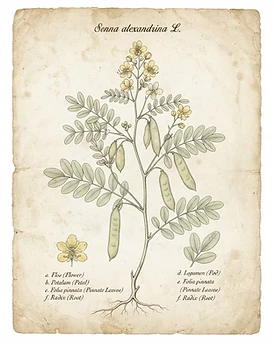
Senna alexandrina
Senna
Fabaceae
Identity
- Common Name
- Senna
- Scientific Name
- Senna alexandrina
- Botanical Family
- Fabaceae
- Native Region
- North Africa and Arabia
- Cultivation Regions
- North Africa, South Asia, tropics
- Plant Parts Used
- Leaves, Seed pods
- Synonyms
- Sickle Senna, Alexandrian Senna, Indian Senna
- Caffeine Level
- Caffeine Free
A slender shrub with pinnate compound pale green oval leaflets, small yellow five-petalled flowers, and flat oblong pale-green seed pods; the leaves and pods are used.
Historical Background
Senna has been an Egyptian, Arabian, and Ayurvedic laxative for millennia, its leaves and pods among the best-known stimulant laxatives in herbal and conventional medicine. Brewed into 'senna tea' for occasional constipation, it is a potent, short-term herb best used with caution.
Earliest recorded uses: Egyptian, Arabian, and Ayurvedic traditions for millennia; a strong laxative leaf and pod.
Traditional preparations:
- Leaf/pod infusion
- Short-term constipation tea
- Practitioner-guided use
Traditional Uses
These uses document historical traditions and do not imply proven effectiveness.
Egyptian and Arabian Traditions
Strong stimulant laxative for occasional constipation.
Modern Herbalism
Short-term laxative cup (sennosides).
Flavor & Aroma
Aroma: Mild, slightly sweet, grassy, faintly floral
Tea Information
Safety & Cautions
Research Summary
Senna has moderate evidence as a short-term stimulant laxative for occasional constipation, via anthraquinone glycosides (sennosides); it is not a treatment for chronic constipation, IBS, weight loss, or any disease, and overuse causes dependency, electrolyte loss, and laxative-abuse risk. Best used briefly and with guidance.
Evidence levels reflect the currently available scientific literature and may change as new research emerges. Where evidence is limited or conflicting, this is stated plainly.
References & Sources
Related Herbs


Trifolium pratense
Red Clover
Fabaceae
Mild, sweet, floral, grassy


Clitoria ternatea
Butterfly Pea
Fabaceae
Earthy, floral, mild, green


Astragalus membranaceus
Astragalus
Fabaceae
Sweet, earthy, bean-like, mild