
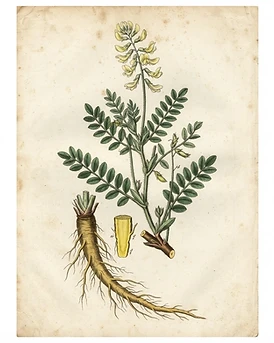
Astragalus membranaceus
Astragalus
Fabaceae
Identity
- Common Name
- Astragalus
- Scientific Name
- Astragalus membranaceus
- Botanical Family
- Fabaceae
- Native Region
- China and Mongolia
- Cultivation Regions
- China, Mongolia, Korea
- Plant Parts Used
- Root
- Synonyms
- Huang Qi, Milk Vetch, Yellow Leader
- Caffeine Level
- Caffeine Free
A perennial member of the pea family with compound pinnate leaves of small oval leaflets, loose racemes of small pale yellow pea-like flowers, and a long fibrous taproot with a pale yellow interior used medicinally.
Historical Background
Astragalus (huang qi, 'yellow leader') has been one of the most important Qi-tonifying herbs of Traditional Chinese Medicine for over 2,000 years, prized for vitality, defense, and stamina. Its sliced root is simmered long into nourishing soups and teas, often with jujube, goji, and ginger, to support convalescence and seasonal resilience.
Earliest recorded uses: Recorded in the Shennong Ben Cao Jing (~2000 years ago) as a superior Qi tonic; a pillar of TCM.
Traditional preparations:
- Root-slice decoction
- Immune soup with jujube & goji
- Longevity congee
Traditional Uses
These uses document historical traditions and do not imply proven effectiveness.
Traditional Chinese Medicine
Tonifies Qi, lifts Spleen, stabilizes the exterior; premier defense and vitality tonic.
Modern Herbalism
Adaptogen and immune tonic for resilience and fatigue.
Flavor & Aroma
Aroma: Sweet, earthy, bean-like, mild
Tea Information
Safety & Cautions
Research Summary
Astragalus is a pillar of TCM as a Qi and immune tonic. Clinical evidence is limited; some trials (often combined with other herbs) suggest possible immune and fatigue benefits, but it is not a treatment for cancer, infection, or any disease, and interacts with immune-suppressive therapy.
Evidence levels reflect the currently available scientific literature and may change as new research emerges. Where evidence is limited or conflicting, this is stated plainly.
References & Sources
Related Herbs

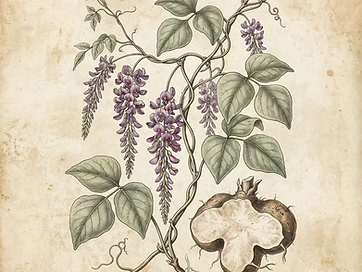
Pueraria lobata
Kudzu
Fabaceae
Sweet, starchy, slightly floral, earthy


Glycyrrhiza glabra
Licorice Root
Fabaceae
Sweet, woody, anise-like


Trifolium pratense
Red Clover
Fabaceae
Mild, sweet, floral, grassy