

Schisandra chinensis
Schisandra
Schisandraceae
Identity
- Common Name
- Schisandra
- Scientific Name
- Schisandra chinensis
- Botanical Family
- Schisandraceae
- Native Region
- Northern China and the Russian Far East
- Cultivation Regions
- China, Russia, Korea
- Plant Parts Used
- Berries
- Synonyms
- Five-Flavor Berry, Wu Wei Zi
- Caffeine Level
- Caffeine Free
A deciduous woody vine with oval leaves and dangling clusters of small red berries whose five tastes — sweet, sour, salty, bitter, and pungent — give it its Chinese name wu wei zi ('five-flavor seed').
Historical Background
Schisandra is a revered TCM tonic — classified among the superior herbs in the Shennong Ben Cao Jing (~100 CE) — used for qi, 'calming the spirit,' supporting the liver, and as an adaptogen. In Russia it was studied in the 20th century as an adaptogen for stamina and endurance.
Earliest recorded uses: Shennong Ben Cao Jing (~1st c. CE) lists it among superior, non-toxic tonics.
Cultural significance: Schisandra's five tastes in one berry are said to nourish the five yin organs in TCM — a botanical emblem of balance, and one of the herbs that bridged TCM and Soviet adaptogen research.
Traditional preparations:
- Berry decoction
- Berry infusion
- Powder
Traditional Uses
These uses document historical traditions and do not imply proven effectiveness.
Traditional Chinese Medicine
Tonic for qi, liver support, calming the spirit; wu wei zi.
Modern Herbalism
Adaptogen for stress, endurance, and focus.
Flavor & Aroma
Aroma: Tart, fruity, complex
Tea Information
Safety & Cautions
Research Summary
Schisandra has a long TCM adaptogen tradition and has been studied in small trials for liver support, endurance, and cognition, but evidence is limited and studies are small and often of poor quality. It is not a treatment for liver disease or fatigue disorders.
Evidence levels reflect the currently available scientific literature and may change as new research emerges. Where evidence is limited or conflicting, this is stated plainly.
References & Sources
Related Herbs


Illicium verum
Star Anise
Schisandraceae
Sweet, licorice-anise, warm

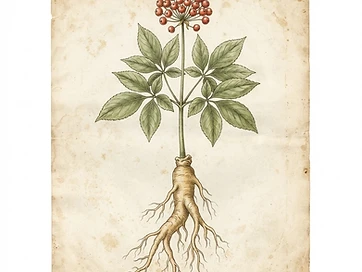
Panax ginseng
Asian Ginseng
Araliaceae
Earthy, sweet, slightly balsamic


Angelica sinensis
Dong Quai
Apiaceae
Musky, earthy, sweet-bitter, aromatic