
Panax ginseng
Asian Ginseng
Araliaceae
Identity
- Common Name
- Asian Ginseng
- Scientific Name
- Panax ginseng
- Botanical Family
- Araliaceae
- Native Region
- Korea, northeastern China, Russian Far East
- Cultivation Regions
- Korea, China, Japan
- Plant Parts Used
- Root
- Synonyms
- Korean Ginseng, Red Ginseng, True Ginseng
- Caffeine Level
- Caffeine Free
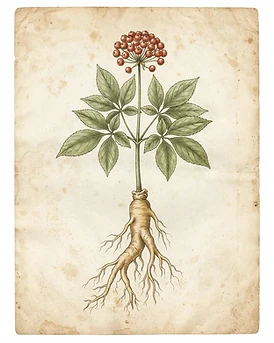
A slow-growing perennial reaching 30–60 cm with a whorl of compound leaves and a central umbel of small greenish-white flowers yielding red berries. The prized forked taproot, often resembling a human figure, is harvested after 4–6 years; steamed and dried roots are known as 'red ginseng.'
Historical Background
Asian ginseng has been revered in East Asian medicine for over 2,000 years, described in the Shennong Bencao Jing (~1st century CE) as a superior tonic for vital energy (qi). It became one of the most prized herbs in the imperial pharmacopoeia and a major trade commodity; modern interest focuses on 'adaptogenic' effects and, for men, on vitality and erectile function.
Earliest recorded uses: Shennong Bencao Jing (1st–2nd century CE) classifies ginseng as a top-grade tonic.
Cultural significance: Ginseng is deeply embedded in Korean and Chinese culture as a symbol of vitality and longevity; wild ginseng was historically worth its weight in gold, and its harvest in mountain forests became a livelihood and a folklore tradition.
1st c. CE
Shennong Bencao Jing records ginseng as a superior tonic.
16th c.
Global ginseng trade expands; American ginseng (P. quinquefolius) discovered as a related species.
20th c.
Soviet researchers coin 'adaptogen' to describe ginseng's stress-response effects.
Traditional preparations:
- Root decoction (simmered 30–45 min)
- Honeyed slices
- Extracts and powders
Traditional Uses
These uses document historical traditions and do not imply proven effectiveness.
Traditional Chinese Medicine
Tonifies qi, supports stamina and recovery; used for fatigue and 'collapse' of energy.
Modern Herbalism
Adaptogen for physical and mental stamina; studied for erectile function.
Flavor & Aroma
Aroma: Earthy, sweet, slightly balsamic
Tea Information
Safety & Cautions
Research Summary
Panax ginseng is widely studied as an adaptogen. Evidence for fatigue and stamina is mixed; some trials suggest modest benefit in chronic fatigue. For erectile dysfunction, a small number of trials of red (steamed) ginseng reported modest improvement compared with placebo, but evidence remains limited and inconsistent. It is not a treatment for low testosterone or a replacement for medical care.
Evidence levels reflect the currently available scientific literature and may change as new research emerges. Where evidence is limited or conflicting, this is stated plainly.
References & Sources
Related Herbs


Angelica sinensis
Dong Quai
Apiaceae
Musky, earthy, sweet-bitter, aromatic

Withania somnifera
Ashwagandha
Solanaceae
Earthy, pungent, horse-like
Eleutherococcus senticosus
Eleuthero
Araliaceae
Earthy, woody