
Eleutherococcus senticosus
Eleuthero
Araliaceae
Identity
- Common Name
- Eleuthero
- Scientific Name
- Eleutherococcus senticosus
- Botanical Family
- Araliaceae
- Native Region
- Siberia, northeastern Asia, Korea, and China
- Plant Parts Used
- Root and rhizome
- Caffeine Level
- None
A prickly shrub reaching 2 to 3 meters, with palmate leaves, small umbels of flowers, and clusters of black berries. The woody roots are the medicinal part.
Historical Background
Long used in Chinese and Russian traditional medicine, eleuthero was intensively studied in the Soviet Union from the 1950s as a cheaper, accessible adaptogen for athletes, cosmonauts, and workers.
Earliest recorded uses: Described in Chinese medicine texts as 'ci wu jia'; adopted into Soviet pharmacology by scientist I.I. Brekhman.
Cultural significance: Soviet researchers promoted eleuthero as a stamina tonic; it was reportedly given to Olympic athletes and explorers to improve recovery.
Traditional preparations:
- Dried root decoction
- Tincture of the root
- Powdered root in capsules
Traditional Uses
These uses document historical traditions and do not imply proven effectiveness.
Traditional Chinese Medicine
Used to tonify qi, strengthen the spleen, and support the kidney.
Soviet/Russian practice
Employed as an adaptogen to enhance stamina and resistance to environmental stress.
Flavor & Aroma
Aroma: Earthy, woody
Tea Information
Safety & Cautions
Research Summary
Some evidence supports use for fatigue and stress resilience, though trials are often small and older; quality modern data is limited.
Evidence levels reflect the currently available scientific literature and may change as new research emerges. Where evidence is limited or conflicting, this is stated plainly.
References & Sources
Related Herbs

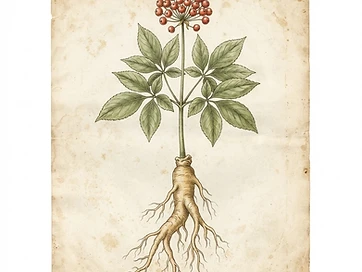
Panax ginseng
Asian Ginseng
Araliaceae
Earthy, sweet, slightly balsamic
Pfaffia paniculata
Suma
Amaranthaceae
Earthy, root-like
Rhodiola rosea
Rhodiola
Crassulaceae
Floral, rose-scented from the root's essential oil