
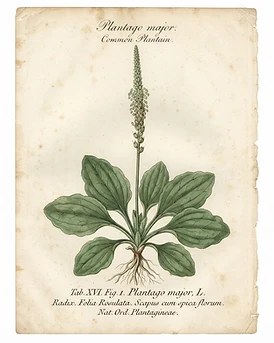
Plantago major
Plantain
Plantaginaceae
Identity
- Common Name
- Plantain
- Scientific Name
- Plantago major
- Botanical Family
- Plantaginaceae
- Native Region
- Europe and temperate Asia
- Cultivation Regions
- Europe, North America, Asia, Australia
- Plant Parts Used
- Leaves, Seeds (psyllium)
- Synonyms
- Common Plantain, Greater Plantain, Waybread, Broadleaf Plantain
- Caffeine Level
- Caffeine Free
A low-growing perennial rosette of broad, oval leaves with prominent parallel veins, sending up slender leafless spikes of tiny greenish-white flowers and seed heads. Hugely common on paths and lawns.
Historical Background
Known across Europe since antiquity as 'the drawing herb' and 'waybread', plantain was a staple of folk first-aid for cuts, insect stings, and inflamed skin. Anglo-Saxon herbals list it among the nine sacred herbs. Its seed husks (psyllium) became a major modern bulk laxative.
Earliest recorded uses: Wound healing (vulnerary), drawing out splinters and venom, soothing inflammation, and respiratory catarrh.
Cultural significance: A ubiquitous 'weed' revered in folk medicine wherever Europeans settled; carried as a protective and healing herb in many traditions.
Classical
Dioscorides and Pliny describe plantain's wound-healing use.
Anglo-Saxon
Listed in the Lacnunga among the nine sacred herbs.
20th century
Psyllium seed husks developed into bulk laxative preparations.
Traditional preparations:
- Fresh leaf poultice
- Warm leaf infusion
- Cool strained infusion as an eyewash or gargle
Traditional Uses
These uses document historical traditions and do not imply proven effectiveness.
Traditional European Herbalism
Fresh crushed leaf applied to bites, minor wounds, and hemorrhoids; leaf infusion as a soothing gargle for sore throat and a gentle expectorant for chest catarrh.
Indigenous Traditions (adopted)
European plantain adopted widely in North American folk practice after introduction.
Flavor & Aroma
Aroma: Faint green and mineral
Tea Information
Safety & Cautions
Research Summary
Mucilage and allantoin in the leaf are credited with the traditional vulnerable and demulcent actions. Most modern evidence concerns psyllium seed husk for constipation and cholesterol; whole-leaf clinical trials are limited.
Evidence levels reflect the currently available scientific literature and may change as new research emerges. Where evidence is limited or conflicting, this is stated plainly.
References & Sources
References & Sources
- American Botanical Council · Expanded Commission E Monographs (Plantago spp. / Psyllium) (2000)
- American Herbal Products Association · Botanical Safety Handbook (2013)
Related Herbs

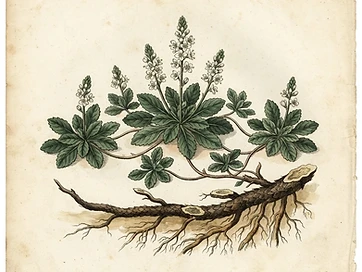
Picrorhiza kurroa
Picrorhiza
Plantaginaceae
Very bitter, earthy, slightly acrid

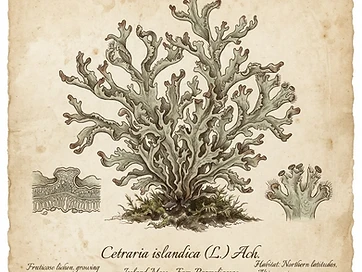
Cetraria islandica
Iceland Moss
Parmeliaceae
Earthy, mineral, faintly green


Plantago major
Plantain (Herb)
Plantaginaceae
Mild, slightly earthy, green, cucumber-like