
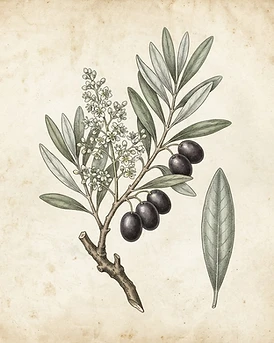
Olea europaea
Olive Leaf
Oleaceae
Identity
- Common Name
- Olive Leaf
- Scientific Name
- Olea europaea
- Botanical Family
- Oleaceae
- Native Region
- Mediterranean basin
- Cultivation Regions
- Mediterranean, Middle East, Australia, California
- Plant Parts Used
- Leaves
- Synonyms
- Olive Leaves, Olea Folium
- Caffeine Level
- Caffeine Free
An evergreen tree with narrow silvery-grey-green leathery leaves, clusters of small white flowers, and purple-black olives; the leaves are the medicinal part, rich in oleuropein.
Historical Background
The olive branch has symbolized peace across the Mediterranean for millennia, but the olive leaf itself was also a healing herb in Egyptian, Greek, and Roman traditions. Brewed as a mild, green tea, olive leaf has become a popular antioxidant infusion in modern herbal practice.
Earliest recorded uses: Ancient Egyptian, Greek, and Mediterranean use; olive leaves symbolized peace and healing for millennia.
Traditional preparations:
- Leaf infusion
- Mediterranean antioxidant blend
- Green-tea pairing
Traditional Uses
These uses document historical traditions and do not imply proven effectiveness.
Traditional European Herbalism
Antioxidant, fever, and wound tea; symbol of peace.
Modern Herbalism
Antioxidant and cardiovascular-support tea.
Flavor & Aroma
Aroma: Mild, green, herbal, slightly astringent
Tea Information
Safety & Cautions
Research Summary
Olive leaf has a tradition as an antioxidant and cardiovascular-support tea, rich in oleuropein. Clinical evidence is limited; small trials suggest modest effects on blood pressure, but it is not a treatment for hypertension, infection, or any disease.
Evidence levels reflect the currently available scientific literature and may change as new research emerges. Where evidence is limited or conflicting, this is stated plainly.
References & Sources
Related Herbs


Equisetum arvense
Horsetail
Equisetaceae
Mild, slightly astringent, green, grassy


Agrimonia eupatoria
Agrimony
Rosaceae
Mild, slightly astringent, honeyed, green


Crataegus monogyna
Hawthorn
Rosaceae
Mild, slightly tart, fruity, green