
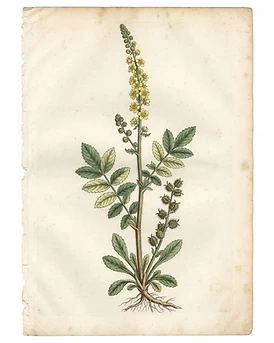
Agrimonia eupatoria
Agrimony
Rosaceae
Identity
- Common Name
- Agrimony
- Scientific Name
- Agrimonia eupatoria
- Botanical Family
- Rosaceae
- Native Region
- Europe and western Asia
- Cultivation Regions
- Europe, North America, Asia
- Plant Parts Used
- Aerial parts
- Synonyms
- Church Steeples, Sticklewort, Cocklebur
- Caffeine Level
- Caffeine Free
An erect perennial with pinnate compound leaves of toothed leaflets and a tall slender spike of small five-petalled yellow flowers, with tiny burr-like fruits below; the aerial parts are the part used.
Historical Background
Agrimony has been a sacred European and Anglo-Saxon herb for millennia, added to healing salves and sipped as a gentle throat and digestive tea. Its slender yellow flower spikes brew a mild, honey-toned cup long associated with wound and throat traditions.
Earliest recorded uses: European and Anglo-Saxon traditions for millennia; a sacred digestive and throat herb.
Traditional preparations:
- Aerial-part infusion
- Throat & digestive tea
- Honeyed folk tonic
Traditional Uses
These uses document historical traditions and do not imply proven effectiveness.
Traditional European Herbalism
Sacred throat, wound, and digestive herb.
Modern Herbalism
Gentle throat and digestive tea.
Flavor & Aroma
Aroma: Mild, slightly astringent, honeyed, green
Tea Information
Safety & Cautions
Research Summary
Agrimony has a long European tradition as a throat and digestive herb; preclinical work shows antioxidant and anti-inflammatory activity. Clinical evidence is insufficient; it is not a treatment for sore throat, IBS, or any disease, though it remains a gentle folk tea.
Evidence levels reflect the currently available scientific literature and may change as new research emerges. Where evidence is limited or conflicting, this is stated plainly.
References & Sources
Related Herbs

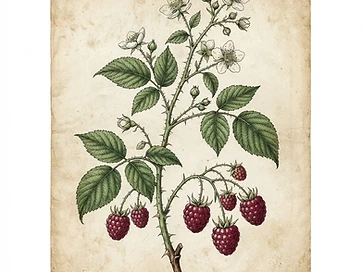
Rubus idaeus
Red Raspberry Leaf
Rosaceae
Fresh, green, faintly fruity


Rubus fruticosus
Blackberry Leaf
Rosaceae
Mild, fruity-tannic, green, slightly earthy


Crataegus monogyna
Hawthorn
Rosaceae
Mild, slightly tart, fruity, green