
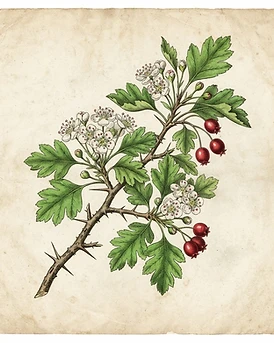
Crataegus monogyna
Hawthorn
Rosaceae
Identity
- Common Name
- Hawthorn
- Scientific Name
- Crataegus monogyna
- Botanical Family
- Rosaceae
- Native Region
- Europe, Asia, North America
- Cultivation Regions
- Europe, North America, Asia
- Plant Parts Used
- Leaves, Flowers, Berries
- Synonyms
- Hawthorn Berry, Mayflower, Whitethorn
- Caffeine Level
- Caffeine Free
A thorny deciduous shrub or small tree with deeply lobed bright green leaves, clusters of small white five-petalled flowers, and small round red berries (haws); the leaves, flowers, and berries are all used.
Historical Background
Hawthorn has been a sacred hedgerow tree of European folklore for millennia, its white May blossoms and red haws long used for heart traditions. A gentle leaf, flower, and berry tea, it became a cornerstone of Western heart-support herbalism.
Earliest recorded uses: European folk and traditional medicine for millennia; a sacred hedgerow tree of fairies and heart traditions.
Traditional preparations:
- Leaf-flower-berry infusion
- Heart-support tea
- Berry decoction
Traditional Uses
These uses document historical traditions and do not imply proven effectiveness.
Traditional European Herbalism
Heart and circulatory herb; sacred hedgerow tree of May.
Modern Herbalism
Heart-support tea (with cardiac drug interactions).
Flavor & Aroma
Aroma: Mild, slightly tart, fruity, green
Tea Information
Safety & Cautions
Research Summary
Hawthorn has moderate evidence from small trials for mild heart-failure support (earlier stage); results vary and quality is mixed. It is not a treatment for heart failure, hypertension, angina, or any disease, and may seriously interact with cardiac medications — use only with clinician oversight.
Evidence levels reflect the currently available scientific literature and may change as new research emerges. Where evidence is limited or conflicting, this is stated plainly.
References & Sources
Related Herbs


Fragaria vesca
Strawberry Leaf
Rosaceae
Mild, fruity, green, lightly sweet


Agrimonia eupatoria
Agrimony
Rosaceae
Mild, slightly astringent, honeyed, green


Rubus fruticosus
Blackberry Leaf
Rosaceae
Mild, fruity-tannic, green, slightly earthy