
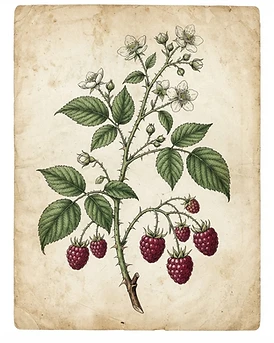
Rubus idaeus
Red Raspberry Leaf
Rosaceae
Identity
- Common Name
- Red Raspberry Leaf
- Scientific Name
- Rubus idaeus
- Botanical Family
- Rosaceae
- Native Region
- Europe and northern Asia
- Cultivation Regions
- Europe, North America, Temperate Asia
- Plant Parts Used
- Leaves
- Synonyms
- Raspberry, Hindberry
- Caffeine Level
- Caffeine Free
A biennial cane shrub 1–2 m tall with compound, serrated, soft green leaves, white five-petaled flowers, and aggregate red berries. The leaves are the medicinal part and are rich in tannins and minerals.
Historical Background
Red raspberry leaf has been a Western women's herbal tonic since at least the 16th century, traditionally steeped in pregnancy to 'tone' the uterus and ease labor. It remains the archetypal 'women's herb' of European and American herbalism, though evidence for its labor effects is limited.
Earliest recorded uses: European herbals of the 16th–17th centuries recommend raspberry leaf for women's complaints; later American eclectic physicians adopted it as a pregnancy tonic.
Cultural significance: Raspberry leaf is the emblem of the Western 'women's tonic' tradition; the fruit itself is a beloved seasonal food and a symbol of summer abundance.
Traditional preparations:
- Leaf infusion (tea)
- Tincture
Traditional Uses
These uses document historical traditions and do not imply proven effectiveness.
Traditional European Herbalism
Leaf tea in later pregnancy to tone the uterus and prepare for labor.
Modern Herbalism
Taken for menstrual comfort and as a general women's tonic.
Flavor & Aroma
Aroma: Fresh, green, faintly fruity
Tea Information
Safety & Cautions
Research Summary
Raspberry leaf is widely used as a 'pregnancy tonic,' but trials have not shown clear benefits for labor outcomes or pain; some small studies suggest possible modest effects on shortening the second stage of labor, but evidence is limited and inconsistent. It is not a proven aid for labor or menstrual disorders.
Evidence levels reflect the currently available scientific literature and may change as new research emerges. Where evidence is limited or conflicting, this is stated plainly.
References & Sources
Related Herbs


Agrimonia eupatoria
Agrimony
Rosaceae
Mild, slightly astringent, honeyed, green


Rubus fruticosus
Blackberry Leaf
Rosaceae
Mild, fruity-tannic, green, slightly earthy


Fragaria vesca
Strawberry Leaf
Rosaceae
Mild, fruity, green, lightly sweet