
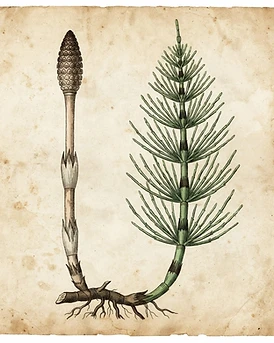
Equisetum arvense
Horsetail
Equisetaceae
Identity
- Common Name
- Horsetail
- Scientific Name
- Equisetum arvense
- Botanical Family
- Equisetaceae
- Native Region
- Temperate regions worldwide
- Cultivation Regions
- Europe, Asia, North America, temperate regions
- Plant Parts Used
- Sterile green stems
- Synonyms
- Shavegrass, Bottlebrush, Scouring Rush
- Caffeine Level
- Caffeine Free
A prehistoric-looking perennial with two stems — a fertile pale brown unbranched stalk tipped with a conical spore cone, and a sterile green stem with whorls of fine needle-like jointed branches; the sterile green stems are used.
Historical Background
Horsetail is a living fossil of an ancient plant family, used in European and Roman herbalism since Galen as a silica-rich urinary and wound herb. Its jointed green stems brew a mild, slightly astringent tea traditionally sipped for urinary and connective-tissue traditions.
Earliest recorded uses: Used in European and Roman herbalism for millennia; a source of silica and a urinary tradition herb since Galen.
Traditional preparations:
- Sterile-stem infusion
- Urinary tea with cornsilk
- Silica tonic blend
Traditional Uses
These uses document historical traditions and do not imply proven effectiveness.
Traditional European Herbalism
Silica-rich urinary and wound herb since Galen.
Modern Herbalism
Urinary and connective-tissue tea.
Flavor & Aroma
Aroma: Mild, slightly astringent, green, grassy
Tea Information
Safety & Cautions
Research Summary
Horsetail has a tradition for urinary and connective-tissue support as a silica source. Clinical evidence is insufficient; it is not a treatment for UTI, osteoporosis, kidney stones, or any disease, and long-term use may strain the kidneys or deplete electrolytes.
Evidence levels reflect the currently available scientific literature and may change as new research emerges. Where evidence is limited or conflicting, this is stated plainly.
References & Sources
Related Herbs


Agrimonia eupatoria
Agrimony
Rosaceae
Mild, slightly astringent, honeyed, green


Olea europaea
Olive Leaf
Oleaceae
Mild, green, herbal, slightly astringent


Symphytum officinale
Comfrey
Boraginaceae
Mild, slightly cucumber-like, green, earthy