
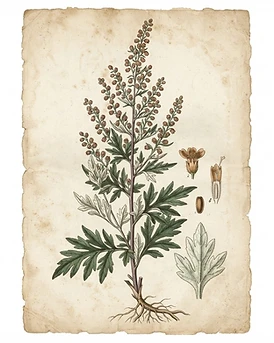
Artemisia vulgaris
Mugwort
Asteraceae
Identity
- Common Name
- Mugwort
- Scientific Name
- Artemisia vulgaris
- Botanical Family
- Asteraceae
- Native Region
- Europe and temperate Asia
- Cultivation Regions
- Europe, Asia, North America, Africa
- Plant Parts Used
- Leaves, Flowering tops
- Synonyms
- Common Mugwort, Ai Ye, Felon Herb
- Caffeine Level
- Caffeine Free
An erect tall perennial with deeply lobed pinnate dark green leaves with white woolly undersides and tall branching panicles of small reddish-brown rayless flower heads; the leaves and flowering tops are used.
Historical Background
Mugwort has been a protective and dream herb of European, Chinese, and Asian traditions for millennia, burned as moxa in TCM (ai ye) and woven into European midsummer charms. Its aromatic, lobed leaves brew a traditional digestive and dream tea, used with care for its thujone content.
Earliest recorded uses: European, Chinese, and Asian traditions for millennia; a protective dream and digestive herb; in TCM as moxa (ai ye).
Traditional preparations:
- Leaf infusion
- Digestive tea with ginger
- Dream tea (short-term)
Traditional Uses
These uses document historical traditions and do not imply proven effectiveness.
Traditional Chinese Medicine
Protective dream and digestive herb; moxa in TCM (ai ye).
Modern Herbalism
Digestive and dream tea (use with care).
Flavor & Aroma
Aroma: Herbal, slightly bitter, aromatic, green
Tea Information
Safety & Cautions
Research Summary
Mugwort has a long tradition as a digestive and dream herb; in TCM, moxa (ai ye) is used in moxibustion. Clinical evidence is insufficient and thujone limits internal use. It is not a treatment for digestive disorders, anxiety, or any disease; avoid in pregnancy and epilepsy.
Evidence levels reflect the currently available scientific literature and may change as new research emerges. Where evidence is limited or conflicting, this is stated plainly.
References & Sources
Related Herbs


Cynara cardunculus
Artichoke Leaf
Asteraceae
Mild, slightly bitter, green, earthy


Carthamus tinctorius
Safflower
Asteraceae
Mild, slightly bitter, green


Lactuca virosa
Wild Lettuce
Asteraceae
Mild, green, slightly bitter, milky