

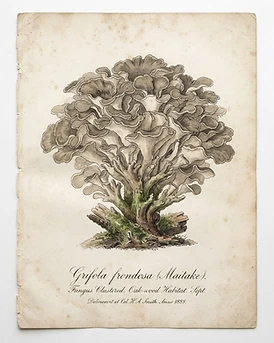
Grifola frondosa
Maitake
Meripilaceae
Identity
- Common Name
- Maitake
- Scientific Name
- Grifola frondosa
- Botanical Family
- Meripilaceae
- Native Region
- Temperate forests of Japan, China, and North America
- Cultivation Regions
- Japan, China, North America
- Plant Parts Used
- Fruiting body, Mycelium extracts
- Synonyms
- Hen of the Woods, Sheep's Head Mushroom, Dancing Mushroom
- Caffeine Level
- Caffeine Free
A large clustered polypore mushroom of overlapping grayish-brown, fan-shaped wavy caps arising from a common base, found at the base of oaks. Prized as food and as a traditional tonic.
Historical Background
Revered in Japanese and Chinese tradition as a strengthening tonic ('dancing mushroom'), maitake became a modern focus for beta-glucan research.
Earliest recorded uses: Vitality, immune support, and general fortification in Japanese and Chinese tradition.
Cultural significance: Valued in Japan as one of the major medicinal mushrooms; traditionally a prized autumn find.
Traditional
Used in Japanese and Chinese practice as a fortifying food-medicine.
Late 20th century
Beta-glucan (D-fraction) becomes a focus of immune research.
Traditional preparations:
- Decoction (broth)
- Reconstituted mushroom tea
Traditional Uses
These uses document historical traditions and do not imply proven effectiveness.
Japanese Traditions
Consumed as a strengthening broth and tonic for vitality and resilience.
Traditional Chinese Medicine
Used to support energy and quiet the spirit.
Flavor & Aroma
Aroma: Deep, foresty, mushroom
Tea Information
Safety & Cautions
Research Summary
Beta-glucans are studied for immunomodulatory and metabolic effects; robust clinical evidence for outcomes remains limited.
Evidence levels reflect the currently available scientific literature and may change as new research emerges. Where evidence is limited or conflicting, this is stated plainly.
References & Sources
References & Sources
- MSK Herbs · About Herbs (medicinal mushrooms) (various)
Related Herbs


Ganoderma lucidum
Reishi
Ganodermataceae
Bitter, earthy, woody, umami


Cordyceps sinensis
Cordyceps
Cordycipitaceae
Earthy, mushroom-like, slightly sweet, savory


Uncaria tomentosa
Cat's Claw
Rubiaceae
Woody, earthy, slightly bitter, herbal