
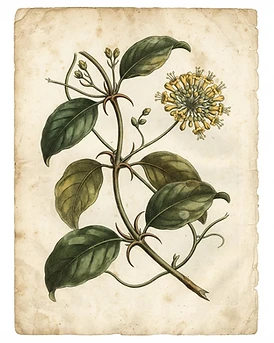
Uncaria tomentosa
Cat's Claw
Rubiaceae
Identity
- Common Name
- Cat's Claw
- Scientific Name
- Uncaria tomentosa
- Botanical Family
- Rubiaceae
- Native Region
- Amazon rainforest (Peru, Brazil)
- Cultivation Regions
- Peru, Brazil, Colombia, Amazon basin
- Plant Parts Used
- Bark, Root
- Synonyms
- Uña de Gato, Amazon Vine, Samento
- Caffeine Level
- Caffeine Free
A large climbing woody vine with opposite large glossy oval leaves and distinctive curved claw-like thorns at the leaf nodes, with small clusters of yellow tubular flowers; the bark and root are the parts used.
Historical Background
Cat's claw (uña de gato) is a sacred climbing vine of the Amazon, used for generations by Indigenous peoples of Peru for immune and inflammatory support. Its curved thorns resemble a cat's claw, and its bark decoction became one of the most popular South American rainforest remedies worldwide.
Earliest recorded uses: Indigenous Amazonian (Asháninka and other) traditions as a bark decoction for immunity and inflammation.
Traditional preparations:
- Bark decoction
- Long-simmered immune tea
- Blended with pau d'arco
Traditional Uses
These uses document historical traditions and do not imply proven effectiveness.
Indigenous South American Traditions
Immune, anti-inflammatory, and vitality bark decoction.
Modern Herbalism
Immune-support and antioxidant bark tea.
Flavor & Aroma
Aroma: Woody, earthy, slightly bitter, herbal
Tea Information
Safety & Cautions
Research Summary
Cat's claw has an Indigenous tradition as an immune and anti-inflammatory bark tea. Clinical evidence is insufficient; preclinical work shows immunomodulatory and anti-inflammatory activity, but it is not a treatment for cancer, arthritis, infection, or any disease.
Evidence levels reflect the currently available scientific literature and may change as new research emerges. Where evidence is limited or conflicting, this is stated plainly.
References & Sources
Related Herbs

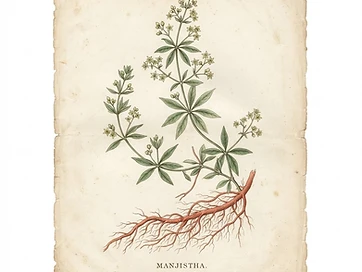
Rubia cordifolia
Manjistha
Rubiaceae
Earthy, slightly bitter, herbaceous


Handroanthus impetiginosus
Pau d'Arco
Bignoniaceae
Earthy, woody, slightly bitter, floral


Inonotus obliquus
Chaga
Hymenochaetaceae
Earthy, vanilla-like, woody, slightly smoky