
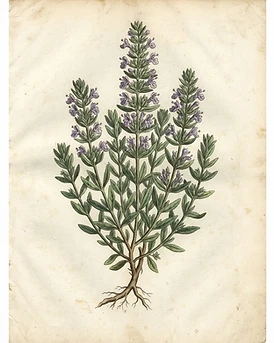
Hyssopus officinalis
Hyssop
Lamiaceae
Identity
- Common Name
- Hyssop
- Scientific Name
- Hyssopus officinalis
- Botanical Family
- Lamiaceae
- Native Region
- Mediterranean and western Asia
- Cultivation Regions
- Mediterranean, Europe, Middle East
- Plant Parts Used
- Aerial parts
- Synonyms
- Holy Herb, Hyssopus, Isop
- Caffeine Level
- Caffeine Free
A compact bushy perennial with small opposite lance-shaped dark green leaves and dense spikes of small tubular two-lipped purple-blue flowers; the aerial parts are the part used.
Historical Background
Hyssop has been a sacred cleansing and respiratory herb of Biblical, Greek, and European traditions for millennia, mentioned in scripture as a purifying plant. Its aromatic spikes brew a gentle, slightly camphor-like tea long sipped for respiratory and digestive comfort.
Earliest recorded uses: Biblical, Greek, and European traditions for millennia; a sacred cleansing and respiratory herb.
Traditional preparations:
- Aerial-part infusion
- Respiratory tea with thyme
- Digestive bitter blend
Traditional Uses
These uses document historical traditions and do not imply proven effectiveness.
Mediterranean Traditions
Sacred cleansing and respiratory herb of scripture.
Modern Herbalism
Respiratory and digestive tea.
Flavor & Aroma
Aroma: Herbal, slightly bitter, camphor-like, minty
Tea Information
Safety & Cautions
Research Summary
Hyssop has a long tradition for respiratory and digestive comfort; preclinical work shows antiviral and antioxidant activity. Clinical evidence is insufficient and the pure essential oil is unsafe internally. It is not a treatment for cough, asthma, infection, or any disease.
Evidence levels reflect the currently available scientific literature and may change as new research emerges. Where evidence is limited or conflicting, this is stated plainly.
References & Sources
Related Herbs

Stachys officinalis
Wood Betony
Lamiaceae
Mild, herbal, slightly bitter, green


Mentha spicata
Spearmint
Lamiaceae
Fresh, sweet, minty, slightly fruity

Monarda didyma
Bergamot (Bee Balm)
Lamiaceae
Earl-grey-like, citrus, minty, herbaceous