
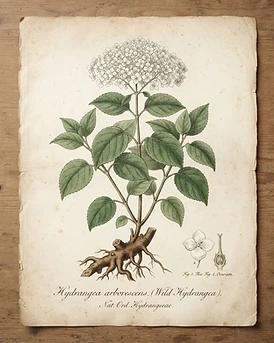
Hydrangea arborescens
Hydrangea Root
Hydrangeaceae
Identity
- Common Name
- Hydrangea Root
- Scientific Name
- Hydrangea arborescens
- Botanical Family
- Hydrangeaceae
- Native Region
- Eastern North America
- Cultivation Regions
- North America, East Asia (related species)
- Plant Parts Used
- Root (dried, peeled)
- Synonyms
- Wild Hydrangea, Seven Barks, Smooth Hydrangea
- Caffeine Level
- Caffeine Free
A deciduous shrub with large opposite oval green leaves and broad clusters of small white flowers; the peeled root is the medicinal part, long used for kidney and urinary concerns.
Historical Background
A Cherokee and early-American remedy for kidney stones ('gravel') and urinary discomfort; later adopted by Eclectic physicians for similar uses.
Earliest recorded uses: Kidney stones ('gravel'), urinary discomfort, and bladder irritation.
Cultural significance: Known as 'seven barks' for its layered peeling root bark; a classic Appalachian kidney remedy.
Indigenous
Cherokee use hydrangea root for kidney and urinary concerns.
19th century
Eclectic physicians adopt it for 'gravel' and bladder stones.
Traditional preparations:
- Root decoction
- Tincture
Traditional Uses
These uses document historical traditions and do not imply proven effectiveness.
Native American Traditions
Root decoction for kidney stones and urinary soothing.
Modern Herbalism
Used for urinary and prostate comfort.
Flavor & Aroma
Aroma: Mild, earthy, rooty
Tea Information
Safety & Cautions
Research Summary
Used largely on traditional grounds; limited modern study of flavonoids and coumarins. Clinical evidence for kidney stone outcomes is lacking.
Evidence levels reflect the currently available scientific literature and may change as new research emerges. Where evidence is limited or conflicting, this is stated plainly.
References & Sources
References & Sources
- American Herbal Products Association · Botanical Safety Handbook (2013)
Related Herbs

Eutrochium purpureum
Gravel Root
Asteraceae
Faint, hay-like, earthy


Eryngium yuccifolium
Eryngo
Apiaceae
Faint, rooty, herbaceous

Cucurbita pepo
Pumpkin Seed
Cucurbitaceae
Nutty, warm