


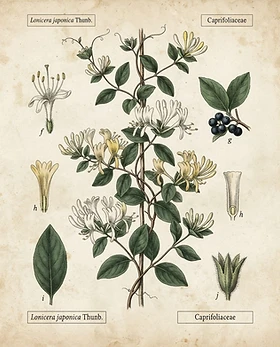
Lonicera japonica
Honeysuckle
Caprifoliaceae
Identity
- Common Name
- Honeysuckle
- Scientific Name
- Lonicera japonica
- Botanical Family
- Caprifoliaceae
- Native Region
- East Asia
- Cultivation Regions
- East Asia, Japan, Korea, worldwide (temperate)
- Plant Parts Used
- Flower buds
- Synonyms
- Jin Yin Hua, Japanese Honeysuckle, Gold-Silver Flower
- Caffeine Level
- Caffeine Free
A twining climbing vine with opposite oval dark green leaves and pairs of long tubular white-and-yellow two-lipped fragrant flowers that age to cream; the flower buds are the part used.
Historical Background
Honeysuckle (jin yin hua, 'gold-silver flower') has been a classic clear-heat herb of Traditional Chinese Medicine for millennia, its fragrant buds steeped for respiratory and early-stage cold traditions. A gentle, honeyed floral tea, it remains a summer staple in East Asia.
Earliest recorded uses: Used in Traditional Chinese Medicine for millennia; a classic clear-heat and respiratory herb (jin yin hua).
Traditional preparations:
- Flower-bud infusion
- Clear-heat TCM formula
- Summer cooling tea with chrysanthemum
Traditional Uses
These uses document historical traditions and do not imply proven effectiveness.
Traditional Chinese Medicine
Clear-heat and respiratory herb (jin yin hua).
Modern Herbalism
Floral clear-heat and respiratory tea.
Flavor & Aroma
Aroma: Sweet, floral, honeyed, slightly green
Tea Information
Safety & Cautions
Research Summary
Honeysuckle has a long TCM tradition for clearing heat and respiratory support; preclinical work shows antiviral and anti-inflammatory activity (chlorogenic acid). Clinical evidence is limited; it is not a treatment for infection, cold, or any disease.
Evidence levels reflect the currently available scientific literature and may change as new research emerges. Where evidence is limited or conflicting, this is stated plainly.
References & Sources
Related Herbs


Sambucus nigra
Elderflower
Adoxaceae
Floral, sweet, slightly green, honeyed

Filipendula ulmaria
Meadowsweet
Rosaceae
Sweet, almond-like, floral, honeyed

Paeonia lactiflora
White Peony
Paeoniaceae
Floral, sweet, slightly bitter, earthy