
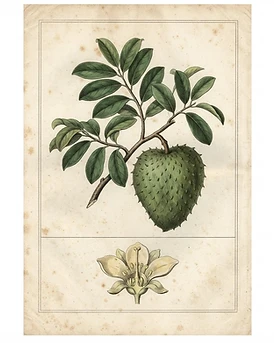
Annona muricata
Graviola (Soursop)
Annonaceae
Identity
- Common Name
- Graviola (Soursop)
- Scientific Name
- Annona muricata
- Botanical Family
- Annonaceae
- Native Region
- Caribbean and tropical Americas
- Cultivation Regions
- Caribbean, Central America, tropics worldwide
- Plant Parts Used
- Leaves, Fruit
- Synonyms
- Soursop, Guanábana, Corossol
- Caffeine Level
- Caffeine Free
A small tropical evergreen tree with large glossy dark green oval leaves, a single large heart-shaped green spiny fruit with soft curved prickles, and creamy-yellow flowers; the leaves and fruit are used.
Historical Background
Graviola (soursop, guanábana) has been a Caribbean and Amazonian fruit and leaf for centuries, its creamy fruit eaten fresh and its leaves brewed as a calming tea. Despite popular claims, clinical evidence is insufficient and long-term high-dose leaf use raises neurological concerns.
Earliest recorded uses: Caribbean, Amazonian, and tropical traditions for centuries; a fruit and leaf used for calming and vitality traditions.
Traditional preparations:
- Leaf infusion
- Calming tropical tea
- Fruit cooler
Traditional Uses
These uses document historical traditions and do not imply proven effectiveness.
Caribbean Traditions
Caribbean and Amazonian calming and vitality tea.
Modern Herbalism
Calming and antioxidant tea (limit use).
Flavor & Aroma
Aroma: Tropical, creamy, slightly sour, fruity
Tea Information
Safety & Cautions
Research Summary
Graviola has a tradition as a calming and antioxidant tea; despite popular claims, clinical evidence is insufficient and it is not a treatment for cancer, infection, or any disease. Long-term high-dose leaf use raises neurological concerns (annonacin) — limit intake.
Evidence levels reflect the currently available scientific literature and may change as new research emerges. Where evidence is limited or conflicting, this is stated plainly.
References & Sources
Related Herbs


Crataegus monogyna
Hawthorn
Rosaceae
Mild, slightly tart, fruity, green


Hippophae rhamnoides
Sea Buckthorn
Elaeagnaceae
Tart, fruity, citrus-like, slightly sweet


Vaccinium myrtillus
Bilberry
Ericaceae
Fruity, slightly tart, green, earthy