
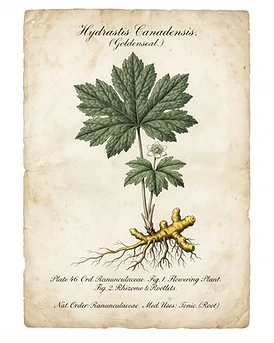
Hydrastis canadensis
Goldenseal
Ranunculaceae
Identity
- Common Name
- Goldenseal
- Scientific Name
- Hydrastis canadensis
- Botanical Family
- Ranunculaceae
- Native Region
- Eastern North America
- Cultivation Regions
- Eastern North America (cultivated)
- Plant Parts Used
- Root (rhizome)
- Synonyms
- Yellow Root, Orange Root, Eyebalm
- Caffeine Level
- Caffeine Free
A low perennial with a single large deeply lobed palmate wrinkled green leaf, a small white flower, and a knobby bright-yellow branching rhizome; the root/rhizome is used.
Historical Background
Goldenseal has been an Indigenous North American medicine for centuries, its vivid yellow berberine-rich root prized for mucous membranes, wounds, and infection. Overharvesting has made it endangered in the wild, and it remains a potent, practitioner-guided bitter herb rather than an everyday tea.
Earliest recorded uses: Indigenous North American traditions for centuries; a bright-yellow bitter root for mucous membranes and infection.
Traditional preparations:
- Small-dose root infusion
- Bitter mucous-membrane tea
- Practitioner-guided use
Traditional Uses
These uses document historical traditions and do not imply proven effectiveness.
Indigenous North American Traditions
Bitter antimicrobial for mucous membranes and wounds.
Modern Herbalism
Practitioner-guided immune and bitter cup (short-term).
Flavor & Aroma
Aroma: Bitter, earthy, slightly astringent
Tea Information
Safety & Cautions
Research Summary
Goldenseal has a tradition as a bitter antimicrobial for mucous membranes and wounds; berberine shows broad antimicrobial and anti-inflammatory activity in vitro. Clinical evidence in humans is limited; it is not a treatment for infection, cold, diarrhea, or any disease, and its endangered status and strong alkaloids warrant cautious, short-term, practitioner-guided use.
Evidence levels reflect the currently available scientific literature and may change as new research emerges. Where evidence is limited or conflicting, this is stated plainly.
References & Sources
Related Herbs

Actaea racemosa
Black Cohosh
Ranunculaceae
Earth, slightly bitter, green

Tinospora cordifolia
Guduchi
Menispermaceae
Bitter, earthy, slightly starchy

Harpagophytum procumbens
Devil's Claw
Pedaliaceae
Earthy, bitter, slightly smoky