
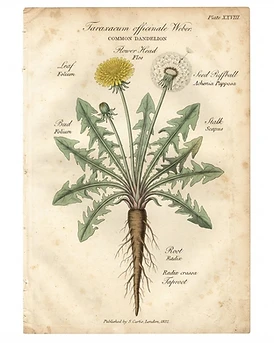
Taraxacum officinale
Dandelion
Asteraceae
Identity
- Common Name
- Dandelion
- Scientific Name
- Taraxacum officinale
- Botanical Family
- Asteraceae
- Native Region
- Eurasia (now cosmopolitan)
- Cultivation Regions
- Worldwide temperate
- Plant Parts Used
- Root, Leaves, Flowers
- Synonyms
- Lion's Tooth, Common Dandelion
- Caffeine Level
- Caffeine Free
A perennial 5–40 cm tall forming a rosette of deeply toothed green leaves, hollow milky stems bearing a single yellow flower head, and a deep taproot; the leaves, flowers, and root are all used.
Historical Background
Dandelion has been a food and medicine of Europe and Asia for over a thousand years — the leaves in spring salads, the roasted root as a coffee substitute, and the flowers in wine. In Western herbalism it is a classic 'liver and kidney' herb and gentle diuretic.
Earliest recorded uses: Arab physicians (10th–11th c.) and European medieval herbals; long used as a spring tonic.
Cultural significance: Dandelion (French dent-de-lion, 'lion's tooth') embodies the resilient wayside herb — maligned as a lawn weed yet valued as food, coffee substitute, and medicine across cultures.
Traditional preparations:
- Root decoction (roasted or fresh)
- Leaf infusion
- Dandelion coffee (roasted root)
Traditional Uses
These uses document historical traditions and do not imply proven effectiveness.
Traditional European Herbalism
Root for liver/digestion; leaf as a gentle diuretic and spring tonic.
Traditional Chinese Medicine
Used for liver heat and detoxification (pu gong ying).
Flavor & Aroma
Aroma: Earthy, bitter, mildly roasted
Tea Information
Safety & Cautions
Research Summary
Dandelion has a long tradition as a digestive and diuretic herb. Clinical evidence is limited; small animal and human studies suggest mild diuretic and prebiotic effects, but robust trials are lacking. It is not a treatment for liver or kidney disease.
Evidence levels reflect the currently available scientific literature and may change as new research emerges. Where evidence is limited or conflicting, this is stated plainly.
References & Sources
Related Herbs

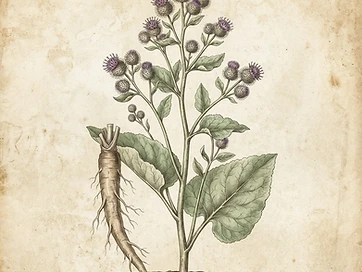
Arctium lappa
Burdock
Asteraceae
Earthy, bitter, slightly sweet, rooty

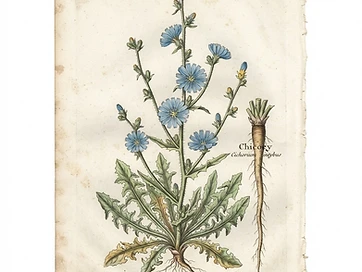
Cichorium intybus
Chicory
Asteraceae
Roasted, nutty, earthy, bitter

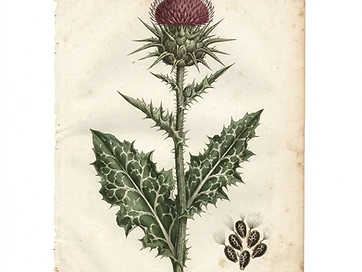
Silybum marianum
Milk Thistle
Asteraceae
Mild, slightly nutty, earthy, green