
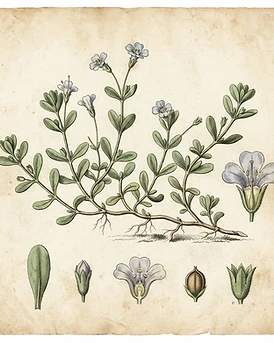
Bacopa monnieri
Brahmi (Bacopa)
Plantaginaceae
Identity
- Common Name
- Brahmi (Bacopa)
- Scientific Name
- Bacopa monnieri
- Botanical Family
- Plantaginaceae
- Native Region
- India, tropical wetlands
- Cultivation Regions
- India, Nepal, Southeast Asia, wetlands
- Plant Parts Used
- Leaves, Aerial parts
- Synonyms
- Water Hyssop, Brahmi, Bacopa
- Caffeine Level
- Caffeine Free
A low creeping succulent perennial with fleshy branching stems, small thick oblong bright-green leaves arranged oppositely, and solitary small five-petaled white to pale blue-violet flowers.
Historical Background
Brahmi (Bacopa monnieri) is one of the most revered medhya (mind-enhancing) rasayanas of Ayurveda, used for over 2,000 years to support memory, learning, and meditation. Its bitter leaves were traditionally prepared with ghee to support the nervous system.
Earliest recorded uses: Ayurvedic texts including Charaka and Sushruta Samhitas; a premier medhya (cognitive) rasayana.
Traditional preparations:
- Leaf infusion
- Ghee-prepared rasayana
- Powder decoction
Traditional Uses
These uses document historical traditions and do not imply proven effectiveness.
Ayurveda
Premier medhya rasayana for memory, learning, and meditation.
Modern Herbalism
Adaptogen for stress and cognitive support.
Flavor & Aroma
Aroma: Bitter, earthy, green, slightly buttery
Tea Information
Safety & Cautions
Research Summary
Brahmi has a strong Ayurvedic tradition for memory and cognition. Several small-to-moderate trials and meta-analyses suggest modest improvements in memory and attention, but effects are gradual and evidence is limited in quality. It is not a treatment for dementia or cognitive disorders.
Evidence levels reflect the currently available scientific literature and may change as new research emerges. Where evidence is limited or conflicting, this is stated plainly.
References & Sources
Related Herbs

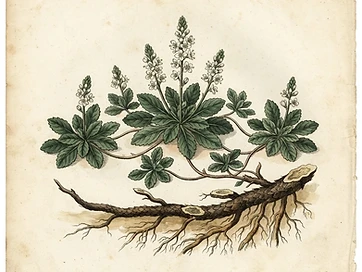
Picrorhiza kurroa
Picrorhiza
Plantaginaceae
Very bitter, earthy, slightly acrid


Plantago major
Plantain (Herb)
Plantaginaceae
Mild, slightly earthy, green, cucumber-like


Nelumbo nucifera
Sacred Lotus
Nelumbonaceae
Mild, slightly sweet, green, earthy