
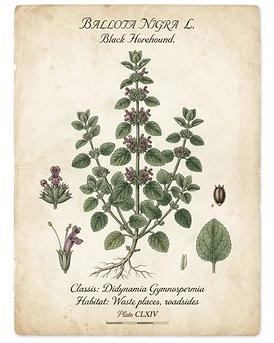
Ballota nigra
Black Horehound
Lamiaceae
Identity
- Common Name
- Black Horehound
- Scientific Name
- Ballota nigra
- Botanical Family
- Lamiaceae
- Native Region
- Europe and the Mediterranean
- Cultivation Regions
- Europe, Mediterranean
- Plant Parts Used
- Aerial parts
- Synonyms
- Black Stinking Horehound, Ballote
- Caffeine Level
- Caffeine Free
A bushy perennial of the mint family with opposite rounded, toothed green leaves and whorls of small tubular reddish-purple flowers along the square stem. Unpleasant-smelling, unlike its cousin white horehound.
Historical Background
Used in European herbalism chiefly for nausea, vomiting, and nervous stomach — distinct from white horehound's cough reputation; long valued for motion-related queasiness.
Earliest recorded uses: Nausea, vomiting, nervous stomach, and motion-related queasiness.
Cultural significance: A traditional 'settling' herb for upset stomach and travel queasiness in European cottage practice.
Medieval
European herbalists use black horehound for nausea and nerves.
Modern
Retained in folk practice for motion-related queasiness.
Traditional preparations:
- Infusion
- Tincture
Traditional Uses
These uses document historical traditions and do not imply proven effectiveness.
Traditional European Herbalism
Infusion for nausea, nervous stomach, and travel queasiness.
Flavor & Aroma
Aroma: Strong, unpleasant, herbaceous
Tea Information
Safety & Cautions
Research Summary
Used almost entirely on traditional grounds; modern clinical evidence is lacking.
Evidence levels reflect the currently available scientific literature and may change as new research emerges. Where evidence is limited or conflicting, this is stated plainly.
References & Sources
References & Sources
- Maud Grieve · A Modern Herbal (historical reference) (1931)
Related Herbs

Marrubium vulgare
Horehound
Lamiaceae
Bitter, earthy, menthol-like, herbaceous


Betonica officinalis
Wood Betony
Lamiaceae
Mild, green and herbaceous
Salvia miltiorrhiza
Danshen
Lamiaceae
Mildly camphoraceous, woody