
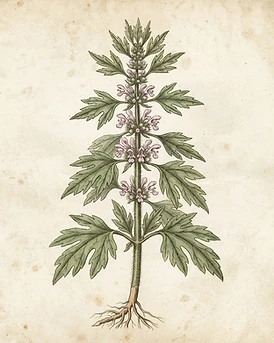
Leonurus cardiaca
Motherwort
Lamiaceae
Identity
- Common Name
- Motherwort
- Scientific Name
- Leonurus cardiaca
- Botanical Family
- Lamiaceae
- Native Region
- Europe and central Asia
- Cultivation Regions
- Europe, Asia, North America
- Plant Parts Used
- Aerial parts
- Synonyms
- Lion's Tail, Yi Mu Cao, Throw-wort
- Caffeine Level
- Caffeine Free
An erect perennial 50-150 cm tall with deeply lobed palmate leaves and small pink-lilac tubular two-lipped flowers arranged in whorls up the stems; the aerial parts are the part used.
Historical Background
Motherwort (yi mu cao, 'mother herb') has been treasured in European, Chinese, and Ayurvedic traditions for centuries for women's and heart-nervine comfort. Its airy whorled flowers and lobed leaves earned it a place as a gentle calming herb for times of tension.
Earliest recorded uses: European and Chinese medicine for centuries; named for its traditional use for women's and heart comfort.
Traditional preparations:
- Aerial-part infusion
- Women's calming blend
- Heart-nervine tea with lemon balm
Traditional Uses
These uses document historical traditions and do not imply proven effectiveness.
Traditional European Herbalism
Women's, heart-nervine, and calming herb.
Traditional Chinese Medicine
Blood-invigorating and women's nervine herb.
Modern Herbalism
Calming nervine for tension (avoid in pregnancy).
Flavor & Aroma
Aroma: Herbal, slightly bitter, green, earthy
Tea Information
Safety & Cautions
Research Summary
Motherwort has a tradition for women's and heart-nervine comfort. Clinical evidence is insufficient; preclinical work shows possible calming and cardiovascular effects, but it is not a treatment for anxiety, heart disease, menopause, or any condition, and should be avoided in pregnancy.
Evidence levels reflect the currently available scientific literature and may change as new research emerges. Where evidence is limited or conflicting, this is stated plainly.
References & Sources
Related Herbs

Stachys officinalis
Wood Betony
Lamiaceae
Mild, herbal, slightly bitter, green


Prunella vulgaris
Self-Heal
Lamiaceae
Mild, slightly bitter, green, earthy


Scutellaria baicalensis
Baikal Skullcap
Lamiaceae
Mild, slightly bitter, green, earthy