
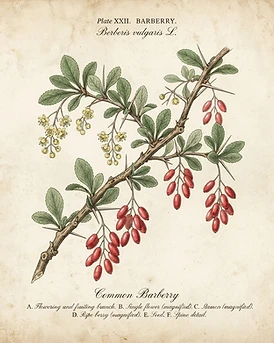
Berberis vulgaris
Barberry
Berberidaceae
Identity
- Common Name
- Barberry
- Scientific Name
- Berberis vulgaris
- Botanical Family
- Berberidaceae
- Native Region
- Europe, North Africa and western Asia
- Cultivation Regions
- Europe, Asia, North America
- Plant Parts Used
- Root bark, Stem bark, Berries (food)
- Synonyms
- Common Barberry, Sourberry, Jaundice Berry
- Caffeine Level
- Caffeine Free
A deciduous shrub with arching branches, sharp triple spines, small oval toothed leaves, drooping clusters of yellow flowers, and elongated tart red berries.
Historical Background
Used since antiquity for liver and gallbladder complaints and as a bitter digestive. Barberry's yellow inner bark (rich in berberine) gave it a place in European and Middle Eastern traditions for 'jaundice'.
Earliest recorded uses: Liver and gallbladder support, fever, digestive stimulation, and as a dye.
Cultural significance: Once blamed for harboring wheat rust fungus and eradicated from European hedgerows; now valued again as a medicinal and culinary plant.
Classical
Arab and European physicians use barberry for liver complaints.
Medieval
Listed as a remedy for 'jaundice' in European herbals.
Modern
Berberine becomes a focus of pharmacological research.
Traditional preparations:
- Decoction of root bark
- Tincture (bitter)
Traditional Uses
These uses document historical traditions and do not imply proven effectiveness.
Traditional European Herbalism
Decoction of root bark as a bitter liver and gallbladder tonic and digestive stimulant.
Middle Eastern Traditions
Used for fevers and gastrointestinal upset.
Flavor & Aroma
Aroma: Sharp, resinous
Tea Information
Safety & Cautions
Research Summary
Berberine is among the most studied plant alkaloids, with clinical research on glucose and lipid metabolism; whole-barberry trials are fewer. Its antibacterial and bile-flow effects have a long traditional basis.
Evidence levels reflect the currently available scientific literature and may change as new research emerges. Where evidence is limited or conflicting, this is stated plainly.
References & Sources
References & Sources
- NIH Office of Dietary Supplements · Berberine — background and emerging research (various)
- American Herbal Products Association · Botanical Safety Handbook (2013)
Related Herbs

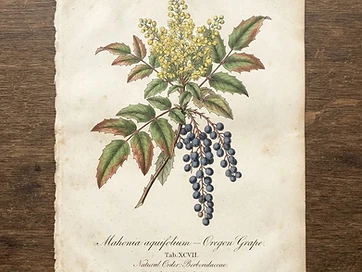
Mahonia aquifolium
Oregon Grape
Berberidaceae
Bitter, tart, slightly fruity, earthy

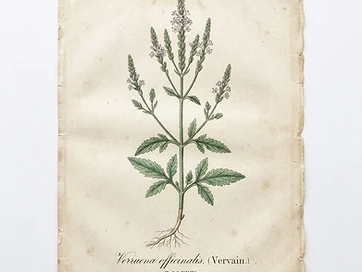
Verbena officinalis
Vervain
Verbenaceae
Faint, green and herbaceous


Eupatorium perfoliatum
Boneset
Asteraceae
Faint, pungent and hay-like