
Trametes versicolor
Turkey Tail
Polyporaceae
Identity
- Common Name
- Turkey Tail
- Scientific Name
- Trametes versicolor
- Botanical Family
- Polyporaceae
- Native Region
- Worldwide temperate forests
- Cultivation Regions
- Worldwide temperate forests (widely foraged & cultivated)
- Plant Parts Used
- Fruiting body, Mycelium
- Synonyms
- Yun Zhi, Kawaratake, Coriolus versicolor
- Caffeine Level
- Caffeine Free
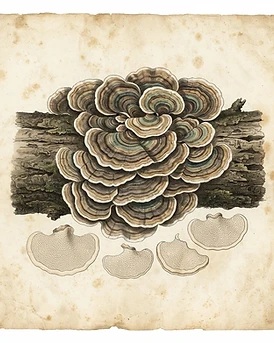
A thin shelf-like bracket fungus growing in overlapping clusters on dead hardwood, each semicircular cap banded with concentric zones of brown, tan, grey and blue-green, with a pale underside of tiny pores.
Historical Background
Turkey tail (yun zhi) has been used in Traditional Chinese and Japanese medicine for centuries as an immune and longevity tonic. Its colorful, fan-like brackets carpet fallen logs worldwide, and a polysaccharide extract (PSK) became a respected adjuvant in Japanese oncology.
Earliest recorded uses: Used in TCM (Yun Zhi) since at least the 15th century; a traditional immune tonic.
Traditional preparations:
- Long decoction of dried brackets
- Daily immune tonic
- Dual extract (off-tea)
Traditional Uses
These uses document historical traditions and do not imply proven effectiveness.
Traditional Chinese Medicine
Immune and spirit tonic; long-life mushroom.
Modern Herbalism
Immune-support and antioxidant decoction.
Flavor & Aroma
Aroma: Earthy, mild, mushroom-like, slightly woody
Tea Information
Safety & Cautions
Research Summary
Turkey tail has a tradition as an immune tonic, and a polysaccharide extract (PSK) has been studied as a cancer adjuvant, mainly in Japan. Evidence is limited for standalone use, and it is not a treatment for cancer, infection, or any disease; use only under oncology supervision.
Evidence levels reflect the currently available scientific literature and may change as new research emerges. Where evidence is limited or conflicting, this is stated plainly.
References & Sources
Related Herbs


Prunella vulgaris
Self-Heal
Lamiaceae
Mild, slightly bitter, green, earthy


Polygonum multiflorum
Fo-Ti
Polygonaceae
Earthy, slightly bitter, starchy, mild


Scutellaria baicalensis
Baikal Skullcap
Lamiaceae
Mild, slightly bitter, green, earthy