
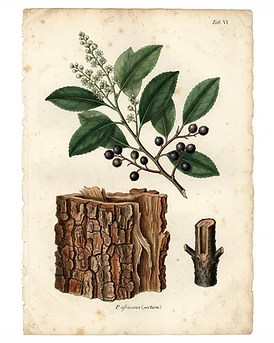
Prunus africana
Pygeum
Rosaceae
Identity
- Common Name
- Pygeum
- Scientific Name
- Prunus africana
- Botanical Family
- Rosaceae
- Native Region
- Sub-Saharan and montane Africa
- Cultivation Regions
- Central Africa, Southern Africa
- Plant Parts Used
- Bark
- Synonyms
- African Plum, Red Stinkwood
- Caffeine Level
- Caffeine Free
An evergreen tree growing up to 35 m with a dark, fissured, aromatic bark, glossy dark green elliptical leaves, and small cream flowers. The bark is the medicinal part and is harvested in strips; overharvesting has threatened wild populations.
Historical Background
The bark of Prunus africana has been used in African traditional medicine for urinary and 'chest' complaints. In the 1960s French researchers developed a standardized bark extract for BPH symptoms, and it became a prescription phytomedicine in parts of Europe — a notable case of traditional African knowledge entering modern pharmacognosy.
Earliest recorded uses: African traditional use of the bark for urinary difficulties; standardized extracts introduced in Europe in the 1970s.
Cultural significance: Pygeum illustrates both the value and the cost of translating traditional medicine into commercial products: demand led to severe overharvesting of wild trees, prompting CITES listing to regulate trade and protect the species.
Pre-colonial
African healers use bark for urinary and respiratory complaints.
1970s
Standardized bark extract marketed in Europe for BPH symptoms.
1995
CITES Appendix II listing to regulate wild bark trade.
Traditional preparations:
- Bark decoction
- Standardized lipid extracts
Traditional Uses
These uses document historical traditions and do not imply proven effectiveness.
African Traditions
Bark decoction for urinary difficulties and general inflammation.
Modern Herbalism
Bark extract used in European phytotherapy for BPH-related urinary symptoms.
Flavor & Aroma
Aroma: Woody, slightly smoky
Tea Information
Safety & Cautions
Research Summary
Pygeum bark extract has been studied for BPH urinary symptoms. A Cochrane review of small, older trials suggested modest improvement in nocturia and peak flow compared with placebo, but the trials were of short duration and low methodological quality, so evidence is limited. It is not a substitute for medical evaluation of prostate conditions.
Evidence levels reflect the currently available scientific literature and may change as new research emerges. Where evidence is limited or conflicting, this is stated plainly.
References & Sources
Related Herbs


Prunus serotina
Wild Cherry Bark
Rosaceae
Bitter almond, woody, aromatic


Rubus fruticosus
Blackberry Leaf
Rosaceae
Mild, fruity-tannic, green, slightly earthy


Fragaria vesca
Strawberry Leaf
Rosaceae
Mild, fruity, green, lightly sweet