
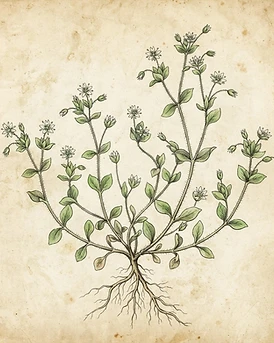
Stellaria media
Chickweed
Caryophyllaceae
Identity
- Common Name
- Chickweed
- Scientific Name
- Stellaria media
- Botanical Family
- Caryophyllaceae
- Native Region
- Europe (cosmopolitan)
- Cultivation Regions
- Europe, Asia, North America, worldwide (temperate)
- Plant Parts Used
- Aerial parts
- Synonyms
- Starweed, Chickenwort, Winterweed
- Caffeine Level
- Caffeine Free
A low sprawling annual with opposite small oval bright green leaves on weak stems bearing a line of fine hairs, and tiny white star-like flowers with five deeply notched petals; the aerial parts are used.
Historical Background
Chickweed has been a common garden 'weed' of European folk tradition for centuries, gathered as a gentle skin and digestive herb. Its tender green stems brew a mild, fresh tea traditionally sipped for soothing and nutritive comfort.
Earliest recorded uses: European folk traditions for centuries; a common garden 'weed' and gentle skin and digestive herb.
Traditional preparations:
- Aerial-part infusion
- Soothing skin & digestive tea
- Nutritive spring blend
Traditional Uses
These uses document historical traditions and do not imply proven effectiveness.
Traditional European Herbalism
Common garden weed; gentle skin and digestive herb.
Modern Herbalism
Soothing and nutritive tea.
Flavor & Aroma
Aroma: Mild, fresh, green, slightly earthy
Tea Information
Safety & Cautions
Research Summary
Chickweed has a folk tradition for skin and digestive comfort; preclinical work shows antioxidant and anti-inflammatory activity. Clinical evidence is insufficient; it is not a treatment for skin disease, digestive disorders, or any condition, though it remains a gentle folk tea.
Evidence levels reflect the currently available scientific literature and may change as new research emerges. Where evidence is limited or conflicting, this is stated plainly.
References & Sources
Related Herbs


Plantago major
Plantain (Herb)
Plantaginaceae
Mild, slightly earthy, green, cucumber-like

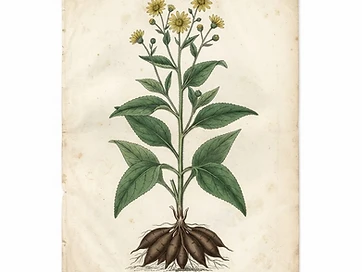
Smallanthus sonchifolius
Yacon
Asteraceae
Sweet, mild, slightly earthy, fresh


Rubus fruticosus
Blackberry Leaf
Rosaceae
Mild, fruity-tannic, green, slightly earthy