
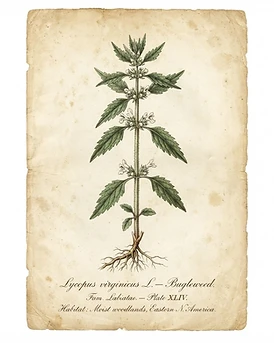
Lycopus virginicus
Bugleweed
Lamiaceae
Identity
- Common Name
- Bugleweed
- Scientific Name
- Lycopus virginicus
- Botanical Family
- Lamiaceae
- Native Region
- Northern Hemisphere temperate regions
- Cultivation Regions
- North America, Europe
- Plant Parts Used
- Aerial parts
- Synonyms
- Gypsywort, Water Horehound, American Bugleweed
- Caffeine Level
- Caffeine Free
A square-stemmed perennial with pairs of deeply toothed lanceolate leaves and tiny white tubular flowers in the leaf axils; the aerial parts are used.
Historical Background
Bugleweed has been a European and North American folk herb for centuries, traditionally sipped for a mild calming effect on the heart and nerves and, in modern times, for overactive thyroid symptoms. Its gentle green brew remains a cautious, practitioner-guided herb.
Earliest recorded uses: European and North American herbal traditions for centuries; a mild calming and thyroid-affecting herb.
Traditional preparations:
- Aerial-part infusion
- Practitioner-guided thyroid cup
Traditional Uses
These uses document historical traditions and do not imply proven effectiveness.
European Folk Traditions
Mild calming heart and nerve herb.
Modern Herbalism
Practitioner-guided overactive-thyroid support.
Flavor & Aroma
Aroma: Mild, green, slightly minty, herbaceous
Tea Information
Safety & Cautions
Research Summary
Bugleweed has a tradition for mild calming and, in modern herbalism, for mild overactive-thyroid symptoms; preclinical work suggests effects on thyroid hormones and heart rate. Clinical evidence is insufficient; it is not a treatment for hyperthyroidism, palpitations, or any disease, and is best used with professional guidance.
Evidence levels reflect the currently available scientific literature and may change as new research emerges. Where evidence is limited or conflicting, this is stated plainly.
References & Sources
Related Herbs


Scutellaria baicalensis
Baikal Skullcap
Lamiaceae
Mild, slightly bitter, green, earthy

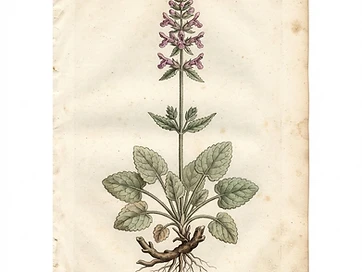
Stachys officinalis
Wood Betony
Lamiaceae
Mild, herbal, slightly bitter, green


Prunella vulgaris
Self-Heal
Lamiaceae
Mild, slightly bitter, green, earthy